
How to Rank for Keywords Miles Away From Your Physical Office
How to Rank for Keywords Miles Away From Your Physical Office: Breaking the Proximity Trap
If you are a local business owner, you’ve likely experienced the “Parking Lot Phenomenon.” You open your phone, search for your primary service while standing in your office, and there you are – Number 1 in the Google Map Pack. But the moment you drive five miles down the road and search again, your business vanishes, replaced by competitors who might not even have half your reviews or experience.
This is what we call the Proximity Trap. For years, Google’s local algorithm has prioritized one thing above all else: how close the searcher is to the business’s physical front door. While this makes sense for coffee shops, it is a nightmare for contractors, lawyers, and service providers who cover an entire region.
As a Local SEO Consultant and Google Business Profile Product Expert, I’ve spent years helping businesses realize that while proximity is a strong signal, it isn’t an unbreakable law. You can expand your ranking radius. In this guide, I’m going to show you how to leverage google business profile seo to dominate the Map Pack 10, 20, or even 40 miles away from your office.
Section 1: The “Proximity Trap” and Why You’re Invisible
Google’s local algorithm relies on three primary pillars: Proximity, Relevance, and Prominence. Proximity is the distance between the searcher and the business. Relevance is how well a business profile matches what the user is searching for. Prominence is how well-known or authoritative the business is in the eyes of Google.
The problem is that Proximity is the “lazy” signal. It’s the easiest for Google to calculate, so it often overrides everything else. Most businesses have a “sweet spot” for local SEO that extends roughly 10 to 15 miles. Beyond that, the signal decays rapidly. If you aren’t optimized, you are essentially invisible to anyone outside your immediate neighborhood.
However, high-authority profiles – those that have mastered the other two pillars – can push their effective reach to a 30-40 mile radius. To do this, you have to stop trying to “fix” proximity (you can’t move your building every day) and start maximizing your relevance and prominence to the point that Google feels obligated to show you to users in distant cities. You need to prove that you are the best choice, even if you aren’t the closest choice.
Section 2: Technical Google Business Profile Optimization
To rank miles away, your profile must be a beacon of technical relevance. This starts with a foundation of google business profile optimization. If Google isn’t 100% sure what you do, it will never risk showing you to someone 15 miles away.
First, look at your categories. Your primary category carries about 75% of the weight, but your secondary categories are what allow you to capture “long-tail” distance searches. If you are a plumber, don’t just stop there. Add “Heating contractor,” “Drainage service,” and “Water filter supplier” if applicable.
Next, the “Services” section is your secret weapon. Most owners just click the suggested services and move on. Instead, you should manually add custom services and write descriptions that include geo-modifiers. Instead of just “Roof Repair,” use “Emergency Roof Repair for [Target City] Homeowners.” This signals to Google that your expertise isn’t geographically limited to your office’s zip code. For more advanced tactics, check out 3 Tiny Profile Edits That Boost Google Maps Ranking Faster Than Citations.
Finally, ensure your business name, address, and phone number (NAP) are consistent, but more importantly, ensure your “Service Areas” are correctly defined in the backend. While these don’t necessarily “rank” you in those areas, they provide a framework for Google to understand your operational boundaries.
Section 3: The Hyperlocal Content Strategy
Your Google Business Profile does not live in a vacuum. It is tethered to your website. If you want to rank in the google map pack for a city 20 miles away, your website needs to prove you belong there. This is where “City Landing Pages” come into play.
There is a common concern on SEO forums and Reddit: “Are city pages spam?” The answer is: only if they are garbage. If you create 50 pages that are identical except for the city name, Google will ghost them. To win, you need hyperlocal content that provides actual value.
Each city page should include:
- Local Landmarks: Mentioning that you provide services near the “Old Town Square” or “Westside High School” helps Google associate your business with that specific geography.
- Neighborhood-Specific Info: Talk about common issues in that specific area (e.g., “Hard water problems in [City Name]”).
- Embedded Google Maps: Not just a map of your office, but a map showing your service radius or a recent project location in that city.
- Customer Reviews from that City: This is the ultimate proximity killer. If you have a review from a customer in a distant city, and that customer mentions the city name, Google’s AI connects the dots.
By building out these pages, you prevent the common issue where your site is ignored by the algorithm. For a deeper dive into this, read How to Stop Your City Landing Pages From Being Ghosted by the 3-Pack.
Section 4: Overcoming the Proximity Limit for Service Area Businesses (SABs)
Service Area Businesses – those who go to the customer and hide their address on Google – face a unique set of challenges. Because you don’t have a public “pin” on the map, Google often defaults to businesses with physical storefronts, even if they are lower quality.
The “Service Area Business Secret” is that prominence can actually override the lack of a physical address. Google’s primary goal is user satisfaction. If you can prove that you are the most prominent and trusted provider in a 30-mile radius, Google will feature your SAB profile over a storefront that has poor ratings.
To bridge this gap, you must focus on “Brand Signals.” This means getting people to search for your business by name in the target city. When Google sees people in [City B] searching for “[Your Business Name] + Plumber,” it realizes that your relevance in [City B] is high despite your office being in [City A]. You can learn more about this in our guide on The Service Area Business Secret for Dominating Local Search Results.
Section 5: Building “Distance Authority” via Local Backlinks & Citations
Generic citations (Yelp, Yellow Pages) are the bare minimum. They won’t help you rank 20 miles away. To build “Distance Authority,” you need backlinks from the specific cities you are targeting. This is a core part of effective local seo ranking tools and strategies.
If your office is in City A, but you want to rank in City B, you should:
- Sponsor a youth sports team in City B.
- Get a link from the City B Chamber of Commerce.
- Partner with a complementary business in City B for a guest blog post (e.g., a roofer linking to a landscaper).
- Issue a press release about a project completed specifically in City B.
These links act as “geographic votes of confidence.” They tell Google, “This business is an active participant in the City B community.” This is significantly more powerful than 100 generic directory links. When you combine this with local map pack seo, your ranking bubble begins to expand naturally.
Section 6: Monitoring the “Grid” and Using Automation
One of the biggest mistakes business owners make is checking their ranking from a single point. If you search from your office and see you are #1, you might think you are winning. But a single ranking number is a lie. Local SEO is a game of inches and miles.
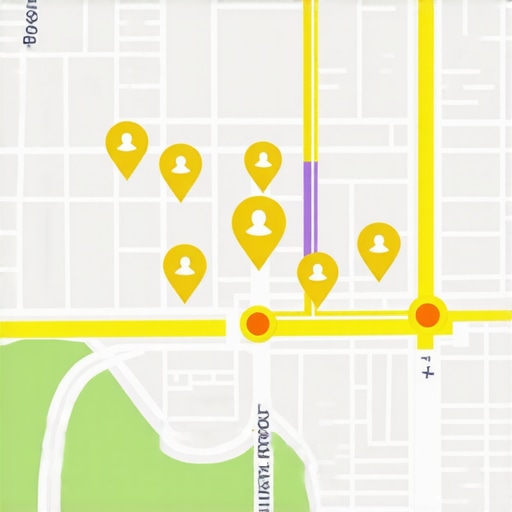
You need to use a google maps rank tracker that provides a grid-based view. This allows you to see exactly where your “ranking bubble” ends. You might be #1 at your office, #3 at the city border, and #14 just five miles further. By visualizing the grid, you can identify “visibility gaps” and target your content and backlink efforts to those specific dead zones.
For many agencies, managing this at scale requires local seo automation tools. Automation allows you to track these grids over time, ensuring that as you push your authority out, you aren’t losing ground in your home territory. Beware of the data though; as I discuss in The Map Grid Trap: Why Your Ranking Software Lies About Real Calls, you must always correlate grid improvements with actual lead volume.
Section 7: Conclusion & Action Plan
Ranking miles away from your physical office isn’t about “tricking” Google; it’s about providing so much relevance and prominence that Google cannot ignore you. By optimizing your technical profile, creating high-value hyperlocal content, and building distance-based authority, you can break the Proximity Trap.
Your action plan is simple: Audit your current reach using a grid tracker, identify your top three target expansion cities, and begin building city-specific landing pages and backlinks. Don’t let a zip code define your business’s growth. Use google business profile seo to take over the map.